Two waterfront listings can sit in the same price bracket, on the same lake, ten minutes apart by boat, and only one of them will still have a usable dock the next time Central Texas goes through a dry stretch. The difference rarely shows up in the listing photos. It shows up in a number most buyers never ask for: the elevation of the shoreline at that specific parcel.
Lake Travis is not a lake in the way a spring-fed swimming hole is a lake. It is a flood-control reservoir that the Lower Colorado River Authority manages by raising and lowering the water line on purpose, sometimes by tens of feet, to balance drinking water supply against flood protection for everyone downstream. That single fact changes what "waterfront" actually guarantees, and it is the piece most waterfront guides skip in favor of square footage and view lines.
A Reservoir Playing the Long Game
As of September 16, 2026, Lake Travis sat at 676.3 feet above mean sea level, 92.3 percent of conservation capacity and 4.7 feet below the lake's full pool mark of 681 feet, according to LCRA gauge data tracked at laketraviswater.com. That is a healthy, boat-friendly reading. It is also a snapshot, not a promise.
Lake Travis has operated across roughly 62 vertical feet in recent memory, from full pool at 681 feet down to 619 feet during the most severe drought stretch the lake has seen. A swing that size does not just change the view from the dock. It changes whether the dock reaches water at all, whether the boat ramp near your subdivision is open, and whether your cove still counts as navigable.
Here is what tends to happen at different points along that range:
Approximate Elevation (ft AMSL) | What It Means on the Ground |
|---|---|
681 (full pool) | Lake at capacity. Docks in shallow coves and narrow inlets are at their most usable. |
665-675 | Normal operating range for most of the year. Open-water docks function without issue. |
650 | Shallow or narrow-cove slips start to crowd together or need to be moved toward deeper water. |
640 | Several public boat ramps around the lake close because the water no longer reaches the ramp surface. |
619 | The lake's recent historic low. Docks built without drawdown in mind can be left high and dry. |
The takeaway is not that Lake Travis is unreliable. It is that "waterfront" describes a range of outcomes, not a fixed condition, and the parcel's elevation determines where in that range a given dock sits.
The Permit You Don't Need Isn't the Rule You Get to Skip
Most buyers hear that LCRA does not require a permit, registration or fee for a residential dock of 1,500 square feet or less and assume that means no rules apply. They do. Every residential dock on the Highland Lakes, regardless of size or permit status, has to meet LCRA's safety standards for flotation, lighting, access, anchoring and maximum distance from shore. The absence of a permit requirement is not the absence of a standard, and an unpermitted dock that fails to meet those standards can still trigger enforcement action.
On Lake Travis specifically, a dock can extend no more than 100 feet from shore, and LCRA requires that there be at least 40 additional feet of open lake access beyond the end of the dock before it will consider the location suitable. Shallow water, narrow coves and rocky terrain can rule a shoreline out entirely, no matter how good it looks from the deck.
There is a second layer worth knowing before you fall in love with a lot. LCRA's conservation and flowage easement on Lake Travis typically extends from the shoreline up to an elevation of 715 feet, roughly 34 feet above full pool. Land within that band is subject to LCRA's shoreline and land-use rules even when it is high and dry most of the year.
A dock that has always been there is not the same thing as a dock that is currently permitted and compliant. A listing photo shows the dock, not whether it is currently permitted and compliant.
If you are buying a home with an existing dock, ask the seller directly for the LCRA approval documentation and permit numbers. Unpermitted or noncompliant structures can complicate both closing and financing.
Same Price Bracket, Different Lake
The elevation story also explains something that looks confusing at first: two waterfront homes can carry similar price tags while offering very different dock experiences, because Lake Travis is not one uniform shoreline.
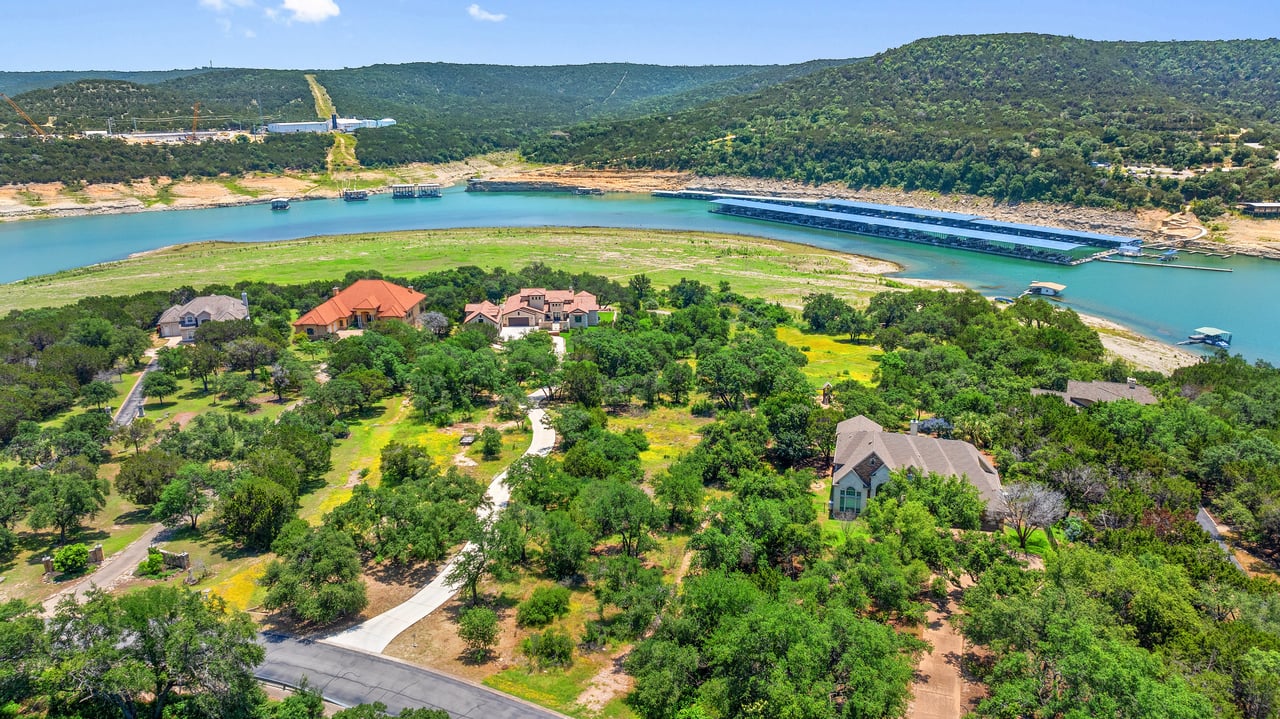
Open-water frontage in Lakeway and Hudson Bend, where the main channel keeps depth even during drawdown, has generally started around $1.5 million in 2026. Cove lots in Lago Vista and Point Venture, tucked into narrower inlets that are more exposed to seasonal shallowing, have offered entry points from the high $600,000s over the same period. Waterfront property broadly has carried a 40 to 80 percent premium over comparable non-waterfront homes this year. That premium buys different things depending on where along the shoreline you land it.
The lake's recent history offers some context for buyers weighing different parts of the shoreline. Hudson Bend, on the south shore, has seen real investment even through fluctuating water years. Lake Travis Lodges Marina there, founded in 1982, was rebuilt by October 2024 and held its grand reopening in May 2025, still positioning itself around deep, reliable access near the main basin. Nautical Boat Club expanded in 2026 to four locations around the lake, including Hudson Bend, Lakeway, Northshore and Volente, explicitly framing the newer Hudson Bend location around its water-to-boat service and the older Lakeway hub around its easy highway access. For buyers, the practical question remains whether a specific dock has reliable depth and access.
Before you write an offer on any waterfront parcel, it is worth confirming a short list directly:
- The parcel's shoreline elevation relative to full pool, not just its lake frontage in linear feet
- Whether an existing dock's LCRA approval is current
- Water depth at the dock location at both current levels and at a lower, historically realistic level
- Whether the cove is wide and deep enough to meet LCRA's 40-foot access standard beyond a 100-foot dock
- The condition of any existing lift or dock structure, since annual inspections on the Highland Lakes have generally run $350 to $650, and a pre-purchase inspection that includes the host dock has run $650 to $1,250
What This Means If You're Comparing Two Docks
The price on a Lake Travis waterfront listing tells you what the market thinks the view and the frontage are worth today. It does not tell you how that dock behaves the next time the lake gives back some of the 62 feet it is capable of giving back. Elevation does that. It is the number that determines whether a boat sits ten feet from the back door or a hundred yards down a dry ramp, and it is worth putting on the same footing as square footage and price per foot when you are comparing two homes that otherwise look alike on paper.
Does a lower lake level cancel my dock's LCRA permit? No, but a lower level can expose problems the permit did not anticipate, such as a lift grounding out or a gangway losing its slope. The permit itself does not expire because the water dropped, but the structure still has to meet LCRA's safety standards at whatever level the lake happens to be.
If the lake is high right now, does that mean my target property is safe long term? Not on its own. A healthy reading like the one recorded in September 2026 reflects current conditions, not a guarantee about the next dry cycle. The parcel's elevation relative to historical lows is a better long-term indicator than the lake's level on the day you tour the house.
Buying waterfront on Lake Travis is still one of the more rewarding moves available in the Austin market, and getting the elevation question right up front is what keeps that reward intact through the lake's normal ups and downs. If you are comparing specific parcels and want a second set of eyes on the dock, the permit history, and what the shoreline actually does at different lake levels, Susan Barringer works this stretch of the Hill Country regularly and can help you sort a strong lot from a pretty photo.
This article is general information, not legal, tax or financial advice. Consult a qualified professional about your situation.